

Asian handicap betting is one of the most powerful tools available to football bettors, yet many UK punters avoid it because the concept seems complicated at first glance. In reality, once you understand the basic principles, Asian handicap markets offer better value, lower margins and more precise betting options than standard match-result markets.
This guide explains every type of Asian handicap — from simple half-goal lines to the often-misunderstood quarter-goal splits — with clear worked examples showing exactly what happens at each scoreline.
What Is Asian Handicap?
An Asian handicap gives one team a virtual goal advantage or disadvantage before the match starts. This eliminates the draw as an outcome (in most cases), reducing the market to two possible results. The team receiving the handicap is the perceived weaker side, while the team giving the handicap is the favourite.
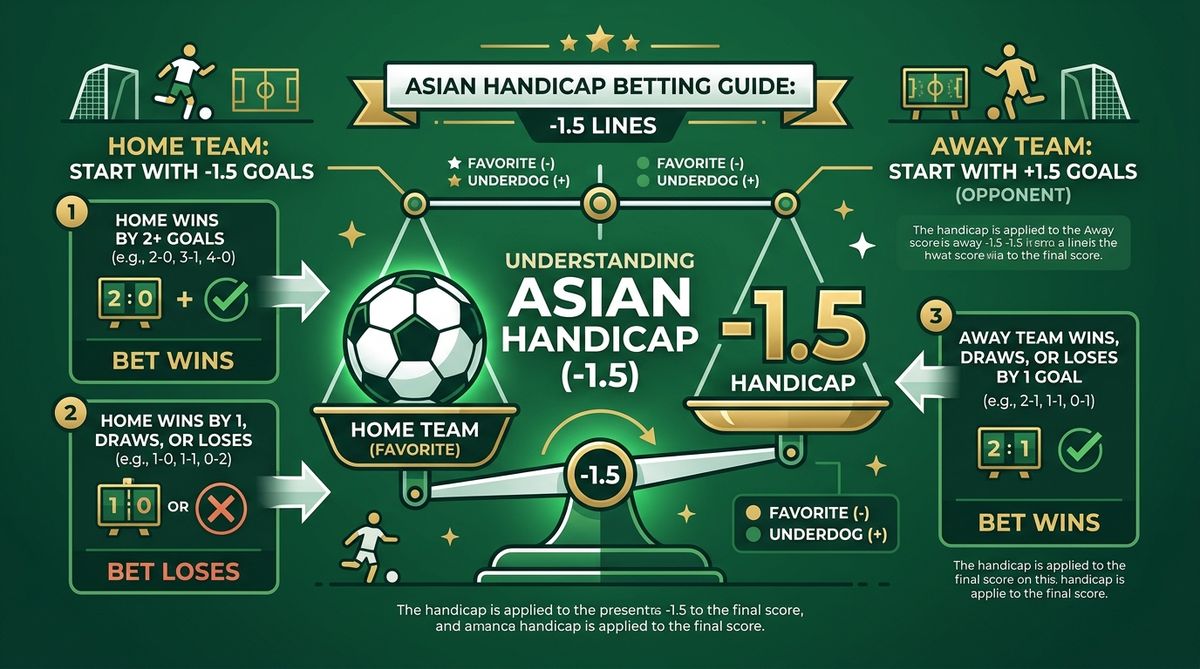
For example, if Manchester City are given a -1.5 handicap against Nottingham Forest, City must win by two or more goals for a bet on them to pay out. Forest, receiving +1.5, only need to avoid losing by two or more goals. Understanding how football odds explained reflect these probabilities is the first step to finding value in handicap markets.
The “Asian” in Asian handicap refers to the origins of this betting style in Southeast Asian markets, where it has been the dominant form of football betting for decades. It was introduced to Western bookmakers in the late 1990s and has grown steadily in popularity.
Why Use Asian Handicap?
There are several compelling reasons to use Asian handicap markets instead of — or alongside — standard match-result betting.
Better odds. Asian handicap markets typically carry lower overrounds than three-way match-result markets. With only two outcomes to price, the bookmaker’s margin is reduced, which means better prices for punters.
Eliminates the draw. The draw is the hardest outcome to predict in football. By removing it (or converting it to a push), Asian handicaps simplify your analysis to a binary question: will this team cover the handicap?
Reduced variance. Whole-goal Asian handicaps offer a push (stake returned) when the result lands exactly on the handicap line. This safety net is not available in standard match-result or European handicap betting.
More precise betting. Quarter-goal and half-goal lines let you fine-tune your position. If you think a favourite will win but are not sure by how many, you can choose a handicap line that gives you partial protection.
Half-Goal Handicaps (-0.5, -1.5, -2.5)
Half-goal handicaps are the simplest to understand because there is no possibility of a push. You either win or lose — the half goal makes a draw on the handicap line impossible.
Worked Example: -0.5 Asian Handicap
Match: Arsenal (-0.5) vs Wolves (+0.5)
You back: Arsenal -0.5 at odds of 1.85 (decimal), £20 stake
- Arsenal win (any score): You WIN. Return: £20 x 1.85 = £37 (£17 profit)
- Draw: You LOSE £20 (Arsenal at -0.5 means they need to win outright)
- Wolves win: You LOSE £20
A -0.5 handicap is essentially the same as backing Arsenal to win on the match result, but typically at slightly better odds.
Worked Example: -1.5 Asian Handicap
Match: Liverpool (-1.5) vs Bournemouth (+1.5)
You back: Liverpool -1.5 at odds of 2.10 (decimal), £15 stake
- Liverpool win by 2+ goals (e.g. 2-0, 3-1): You WIN. Return: £15 x 2.10 = £31.50
- Liverpool win by exactly 1 goal (e.g. 1-0, 2-1): You LOSE £15
- Draw or Bournemouth win: You LOSE £15
Quarter-Goal Handicaps (-0.25, -0.75, -1.25, -1.75)
Quarter-goal handicaps are where Asian handicap betting becomes truly distinctive. Your stake is automatically split into two equal bets on the two nearest half-goal lines. This is sometimes called a “split ball” handicap.
How -0.25 Works (Split into 0 and -0.5)
Match: Chelsea (-0.25) vs Everton (+0.25)
You back: Chelsea -0.25 at odds of 1.90, £20 stake
Your £20 is split: £10 on Chelsea 0 (level) and £10 on Chelsea -0.5
- Chelsea win: Both halves WIN. Return: (£10 x 1.90) + (£10 x 1.90) = £38
- Draw: The 0 half PUSHES (£10 returned), the -0.5 half LOSES. Return: £10 (you lose £10 overall)
- Everton win: Both halves LOSE. Return: £0
How -0.75 Works (Split into -0.5 and -1.0)
Match: Man City (-0.75) vs Newcastle (+0.75)
You back: Man City -0.75 at odds of 1.95, £20 stake
Your £20 is split: £10 on City -0.5 and £10 on City -1.0
- City win by 2+: Both halves WIN. Return: (£10 x 1.95) + (£10 x 1.95) = £39
- City win by exactly 1: The -0.5 half WINS, the -1.0 half PUSHES. Return: (£10 x 1.95) + £10 = £29.50
- Draw: Both halves LOSE. Return: £0
- Newcastle win: Both halves LOSE. Return: £0
Full-Goal Handicaps (0, -1, -2)
Full-goal Asian handicaps work like standard handicaps but with one crucial difference: if the result lands exactly on the handicap line, your stake is returned as a push rather than settling as a loss.
The most common full-goal handicap is the 0 line, also known as the “draw no bet” market. If you back a team at 0 Asian handicap, you win if they win, get your stake back if it is a draw, and lose if the opposition wins.
A -1 Asian handicap means the team must win by two or more goals for you to win. If they win by exactly one goal, your stake is returned. If the match draws or the opposition wins, you lose. This makes it a popular market for backing strong favourites in football betting guide with partial downside protection.
Asian Handicap Results Table
This table shows what happens to your bet at every common handicap line, depending on the match result. Use it as a quick reference when placing your bets.
| Handicap | Team Wins by 2+ | Team Wins by 1 | Draw | Team Loses |
|---|---|---|---|---|
| 0 (DNB) | Win | Win | Push | Lose |
| -0.25 | Win | Win | Half Lose | Lose |
| -0.5 | Win | Win | Lose | Lose |
| -0.75 | Win | Half Win | Lose | Lose |
| -1 | Win | Push | Lose | Lose |
| -1.25 | Win | Half Lose | Lose | Lose |
| -1.5 | Win | Lose | Lose | Lose |
| -1.75 | Half Win | Lose | Lose | Lose |
| -2 | Push (if exactly 2), Win (if 3+) | Lose | Lose | Lose |
“Half Win” means one half of your split stake wins and the other half pushes. “Half Lose” means one half pushes and the other half loses.
Asian Handicap vs European Handicap
UK bettors often confuse Asian and European handicaps because both apply a goal head start. The differences are significant and affect both your risk and your potential returns.
| Feature | Asian Handicap | European Handicap |
|---|---|---|
| Possible outcomes | 2 (win or lose, with push on whole goals) | 3 (win, draw, lose) |
| Draw result | Push (stake returned) or eliminated | Counts as a loss unless you backed the draw |
| Half/quarter lines | Yes (-0.5, -0.25, -0.75 etc.) | No (whole goals only) |
| Typical overround | 2-4% | 5-10% |
| Split stakes | Yes (on quarter-goal lines) | No |
| Popularity | Dominant in Asia, growing in UK | Common in UK and Europe |
For most bettors, Asian handicap offers superior value because of the lower margins and the push protection on whole-goal lines. European handicap is simpler to understand but comes at a cost: the bookmaker charges a higher margin for the three-outcome market.
Worked Examples with Full Outcomes
Let us walk through a complete match scenario to see how different handicap lines settle. Consider a Premier League match between Tottenham and Brighton where the final score is Tottenham 2-1 Brighton.
Scenario: Tottenham 2-1 Brighton (Tottenham Win by 1)
Assume a £20 stake on Tottenham at each handicap line:
- Tottenham 0 (1.50): WIN — Return: £30
- Tottenham -0.25 (1.65): WIN — Return: £33
- Tottenham -0.5 (1.85): WIN — Return: £37
- Tottenham -0.75 (2.00): HALF WIN — The -0.5 half wins (£10 x 2.00 = £20), the -1.0 half pushes (£10 returned). Return: £30
- Tottenham -1 (2.15): PUSH — Stake returned. Return: £20
- Tottenham -1.25 (2.30): HALF LOSE — The -1.0 half pushes (£10 returned), the -1.5 half loses. Return: £10
- Tottenham -1.5 (2.50): LOSE — Return: £0
This example illustrates the sliding scale of risk and reward across handicap lines. The more aggressive the handicap, the higher the odds but the greater the chance of losing. Choosing the right line depends on how confident you are in the margin of victory.
Asian handicap markets are particularly useful when combined with in-play betting guide, as handicap lines shift throughout the match in response to goals and momentum changes.
Best for Asian Handicap Betting
Bet365 offers one of the widest ranges of Asian handicap markets in the UK, covering matches from the Premier League down to lower leagues and international football. Their interface clearly displays all available handicap lines with competitive pricing.
Read Our Bet365 Review
18+. T&Cs apply. BeGambleAware.org
Frequently Asked Questions
What is Asian handicap betting?
Asian handicap betting eliminates the draw option by giving one team a goal advantage or disadvantage before kick-off. This reduces the market to two outcomes instead of three, often resulting in better odds for the punter. Handicaps come in whole goals (0, -1, -2), half goals (-0.5, -1.5) and quarter goals (-0.25, -0.75), each with different settlement rules.
What happens if the Asian handicap result is a draw?
With whole-goal Asian handicaps (0, -1, -2), a draw after the handicap is applied results in a push — your stake is returned in full. With half-goal handicaps (-0.5, -1.5), a draw is impossible, so you always win or lose. With quarter-goal handicaps (-0.25, -0.75), your stake is split into two halves, and one half may push while the other wins or loses.
How do quarter-goal Asian handicaps work?
Quarter-goal handicaps (e.g., -0.25, +0.75) split your stake into two equal bets on the nearest half-goal lines. A -0.25 handicap splits into one bet at 0 (level) and one at -0.5. If the team wins, both halves pay out. If the match draws, the 0 half pushes (stake returned) and the -0.5 half loses. If the team loses, both halves lose.
What is the difference between Asian handicap and European handicap?
The key difference is that European handicap betting retains the draw as a possible outcome, while Asian handicap eliminates it. A European -1 handicap has three outcomes: win, draw, lose. An Asian -1 handicap has only two: win or lose, with a draw resulting in a push (stake returned). Asian handicaps also offer half and quarter-goal lines that European handicaps do not.
Why do professional bettors prefer Asian handicap markets?
Professional bettors prefer Asian handicap markets because they typically have lower overrounds (bookmaker margins) than standard match-result markets, meaning better value. The two-outcome structure also makes analysis simpler, and the push mechanism on whole-goal lines reduces variance. Additionally, Asian handicap markets often have higher betting limits, which matters for serious punters.