

If you want to place smarter football bets, you need to understand how odds work. Odds tell you two things: how likely the bookmaker thinks an outcome is, and how much you stand to win. This guide breaks down every odds format you will encounter at UK bookmakers, shows you how to calculate your returns, and explains how to spot value in the market.
Whether you are new to football betting guide or want to sharpen your understanding before trying a bet builder guide, this page covers everything you need to know.
Fractional Odds
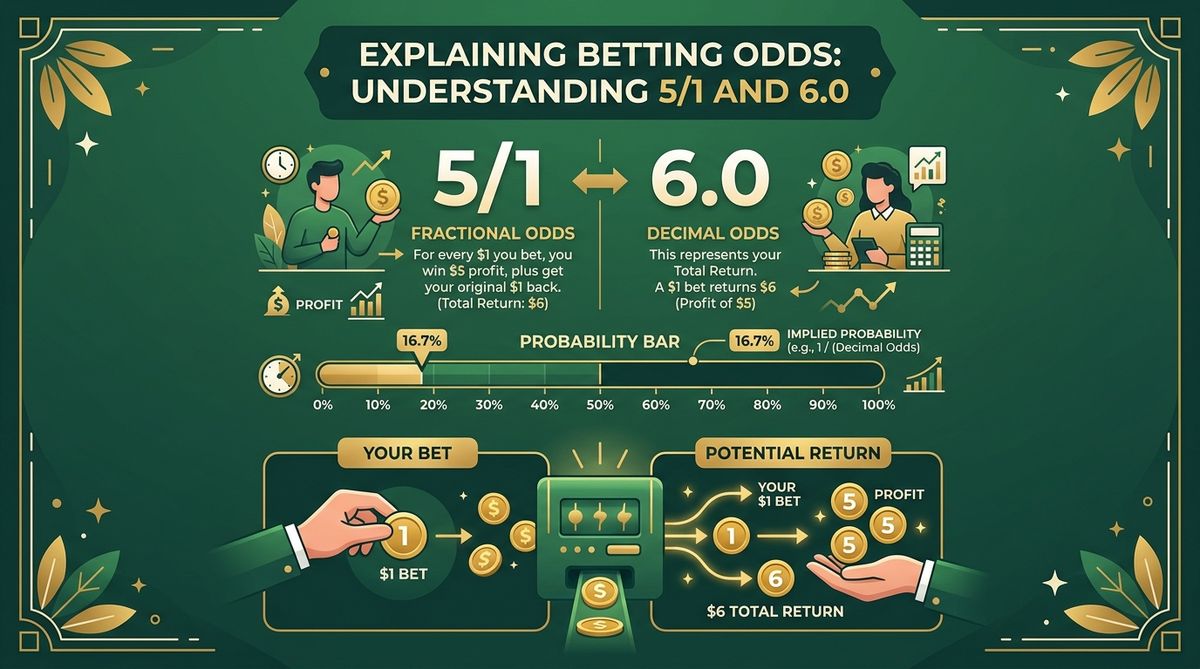
Fractional odds are the traditional UK format and the one you will see most often on television, in betting shops and across British bookmaker sites. They are written as two numbers separated by a slash, such as 5/1 (spoken as “five to one”) or 4/6 (spoken as “four to six on”).
The first number represents your potential profit, and the second number represents the stake you need to place. At 5/1, every pound you stake returns five pounds of profit. At 4/6, you stake six pounds to win four pounds of profit.
Worked Example: Fractional Odds
You back Arsenal to beat Wolves at 4/1 with a £10 stake.
Profit: £10 x 4 = £40
Total return: £40 + £10 (stake) = £50
When the first number is smaller than the second (e.g. 4/6), the selection is “odds on” — meaning the bookmaker considers it more likely to happen than not. You risk more than you stand to gain in profit, but you still get your stake back if the bet wins.
Decimal Odds
Decimal odds are the standard across Europe and increasingly popular with UK punters. They show your total return per pound staked, including your original stake. Decimal odds of 3.00 mean a £1 bet returns £3 (£2 profit plus your £1 stake).
Many bettors prefer decimals because the calculation is simpler: multiply your stake by the decimal odds to get your total return. There is no need to add the stake back on separately.
Worked Example: Decimal Odds
You back Liverpool at decimal odds of 2.50 with a £10 stake.
Total return: £10 x 2.50 = £25
Profit: £25 – £10 (stake) = £15
American Odds (Moneyline)
American odds use a plus or minus sign. Positive odds (+200) show the profit from a £100 stake. Negative odds (-150) show how much you must stake to win £100 profit. You will rarely encounter this format on UK sites, but it appears on some international exchanges and US-focused media.
For day-to-day UK football betting, you can safely ignore American odds. If you do see them, use the conversion table below to translate into fractional or decimal format.
Implied Probability
Every set of odds carries an implied probability — the bookmaker’s estimate of how likely an outcome is. Understanding this is vital if you want to assess whether odds offer genuine value or not.
How to Calculate Implied Probability
From fractional odds (a/b): Probability = b / (a + b) x 100
From decimal odds (d): Probability = (1 / d) x 100
Example: Odds of 2/1 → 1 / (2 + 1) x 100 = 33.3%
Example: Decimal 1.50 → (1 / 1.50) x 100 = 66.7%
If you think a team has a better chance of winning than the implied probability suggests, the bet may represent value. We cover this in more detail in the finding value section below.
Odds Conversion Table
Use this table to convert between fractional, decimal and American odds at a glance. The implied probability column shows the bookmaker’s estimated chance of the outcome occurring.
| Fractional | Decimal | American | Implied Probability |
|---|---|---|---|
| 1/10 | 1.10 | -1000 | 90.9% |
| 1/5 | 1.20 | -500 | 83.3% |
| 1/3 | 1.33 | -300 | 75.0% |
| 1/2 | 1.50 | -200 | 66.7% |
| 4/6 | 1.67 | -150 | 60.0% |
| Evens | 2.00 | +100 | 50.0% |
| 6/4 | 2.50 | +150 | 40.0% |
| 2/1 | 3.00 | +200 | 33.3% |
| 3/1 | 4.00 | +300 | 25.0% |
| 5/1 | 6.00 | +500 | 16.7% |
| 10/1 | 11.00 | +1000 | 9.1% |
| 20/1 | 21.00 | +2000 | 4.8% |
How Bookmakers Set Odds
Bookmakers employ teams of traders and analysts who use statistical models, historical data and current form to set their initial prices. Once a market goes live, odds shift in response to the weight of money placed by customers. If large sums are wagered on one outcome, the bookmaker shortens those odds and pushes the other outcomes out to balance their liability.
External factors also move the market. Team news, injuries, weather and even social media trends can cause rapid odds shifts, particularly close to kick-off. Understanding why odds move helps you time your bets more effectively — a topic we explore in our in-play betting guide.
The Overround Explained
The overround is the bookmaker’s profit margin built into every market. In a perfectly fair market, the implied probabilities of all outcomes would add up to exactly 100%. In practice, they always add up to more — typically 105% to 110% for a Premier League match result market.
| Outcome | Decimal Odds | Implied Probability |
|---|---|---|
| Man City Win | 1.65 | 60.6% |
| Draw | 4.00 | 25.0% |
| Aston Villa Win | 5.50 | 18.2% |
| Total | 103.8% |
Calculating the Overround
Add together the implied probabilities of every outcome in the market. The amount above 100% is the overround.
In the example above: 60.6% + 25.0% + 18.2% = 103.8%
The overround is 3.8%, which represents the bookmaker’s theoretical margin on this market.
Lower overrounds mean better value for the punter. Betting exchanges typically offer the lowest overrounds, while accumulator markets often carry higher margins. Comparing odds across multiple bookmakers helps you reduce the impact of the overround on your bets.
Finding Value in Odds
A value bet exists when the odds offered are higher than the true probability of the outcome. Professional bettors focus entirely on value rather than simply picking winners. A bet at 5/1 on a team you believe has a 25% chance of winning is a value bet, because the odds imply only a 16.7% chance.
To find value consistently, you need to develop your own assessment of probabilities. Study form, head-to-head records, expected goals data and team news before comparing your estimate to the bookmaker’s implied probability. Even small edges compound over time.
Value Bet Worked Example
A bookmaker offers 3/1 (4.00 decimal) on Brighton to beat Wolves.
Implied probability: 25%
Your estimated probability: 35%
Because 35% is greater than 25%, this is a value bet. Over the long run, backing these selections will generate profit even though many individual bets will lose.
Odds comparison is the simplest route to better value. Different bookmakers price the same markets differently, and taking the best available price on every bet adds up significantly over hundreds of wagers. Explore our guide to asian handicap explained for another way to find value in football markets.
Ready to Start Betting?
Bet365 offers competitive football odds across hundreds of markets, including match result, correct score and goalscorer bets. They display both fractional and decimal odds, making it easy to follow along with everything you have learned in this guide.
Read Our Bet365 Review
18+. T&Cs apply. BeGambleAware.org
Frequently Asked Questions
What are the most common odds formats in UK football betting?
The most common odds format in UK football betting is fractional odds (e.g., 5/1, 2/1, 4/6). Decimal odds (e.g., 6.0, 3.0, 1.67) are the second most popular and are the standard in Europe. Most UK bookmakers let you switch between the two formats in your account settings.
How do I calculate my winnings from fractional odds?
To calculate winnings from fractional odds, multiply your stake by the fraction. For example, at odds of 5/1 with a £10 stake, your profit is £10 x 5 = £50, and your total return is £60 (profit plus your original £10 stake). For odds like 4/6, your profit would be £10 x (4/6) = £6.67, with a total return of £16.67.
What is implied probability in football betting?
Implied probability is the likelihood of an outcome happening according to the bookmaker’s odds. You calculate it by dividing the denominator plus the numerator into the denominator for fractional odds, or dividing 1 by the decimal odds. For example, odds of 2/1 imply a 33.3% chance, while decimal odds of 1.50 imply a 66.7% chance.
What is the overround in football betting?
The overround (also called the vig or juice) is the bookmaker’s built-in profit margin. It means the implied probabilities of all outcomes in a market add up to more than 100%. A typical Premier League match might have an overround of 105-108%, meaning the bookmaker expects to keep around 5-8% of all money wagered regardless of the result.
How do I find value in football odds?
You find value by comparing your own assessment of a probability with the implied probability from the odds. If you believe a team has a 50% chance of winning but the odds imply only a 40% chance, that bet has value. Comparing odds across multiple bookmakers also helps you find the best price for any given selection.