

What Is Responsible Gambling?
Responsible gambling means treating betting as a form of entertainment rather than a way to make money. It involves making informed decisions about how much time and money you spend, setting firm limits before you start, and knowing when to walk away. Gambling becomes a problem when it stops being enjoyable and starts causing financial, emotional, or social harm.
The UK gambling industry is regulated by the UK Gambling Commission (UKGC), which requires all licensed operators to promote responsible gambling and provide tools to help customers stay in control. At bettingguides.co.uk, we believe that understanding the risks is just as important as understanding the odds.
Problem gambling affects approximately 0.5% of the UK adult population, according to NHS Digital, but a further 3.8% are classified as at-risk gamblers. These figures demonstrate why responsible gambling practices matter for everyone who places a bet, regardless of how often or how much they wager.
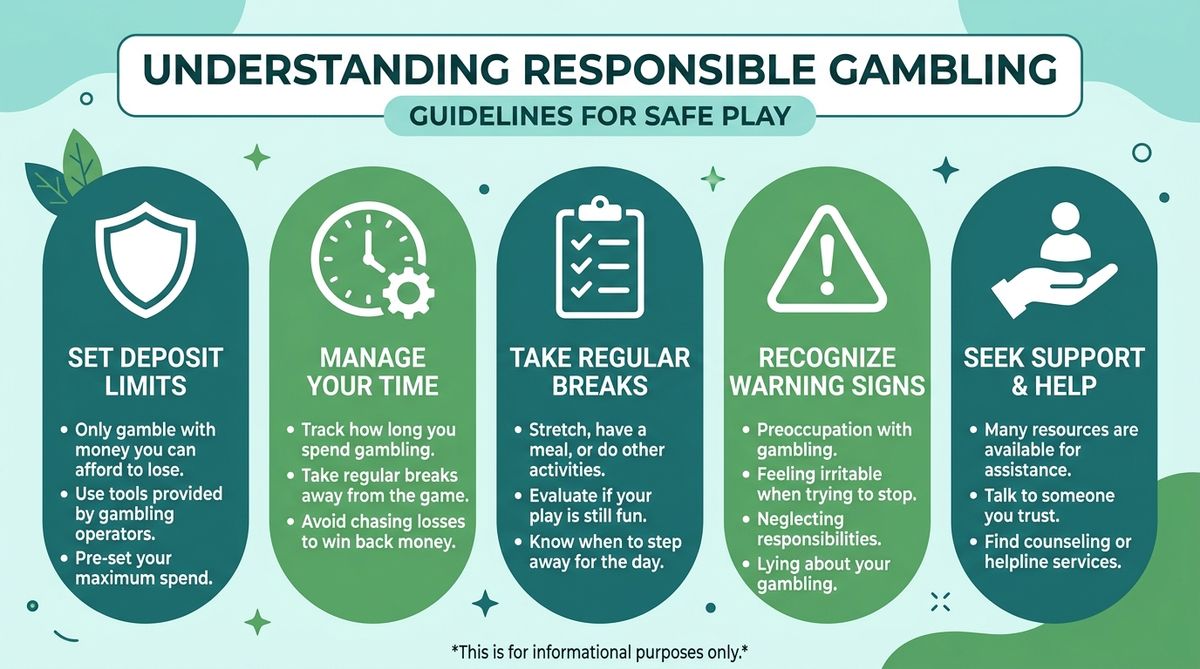
Recognising the Warning Signs
Problem gambling rarely develops overnight. It typically builds gradually, and early warning signs can be easy to dismiss or overlook. Being honest with yourself about your gambling behaviour is the first step towards staying in control.
If you find yourself experiencing any of the following, it may be time to reassess your relationship with gambling and seek advice from a professional support service.
- Chasing losses — placing larger or more frequent bets to try to recover money you have already lost.
- Borrowing to gamble — taking out loans, using credit cards, or borrowing from friends and family to fund your betting.
- Hiding your gambling — lying to partners, family, or friends about how much time or money you spend gambling.
- Neglecting responsibilities — missing work, ignoring family commitments, or falling behind on bills because of time spent gambling.
- Betting more than you can afford — regularly spending beyond your pre-set budget or using money earmarked for essentials.
- Emotional gambling — betting when you feel stressed, anxious, depressed, or under the influence of alcohol.
- Difficulty stopping — feeling restless or irritable when you attempt to cut back or stop gambling entirely.
- Preoccupation — constantly thinking about gambling, planning your next bet, or reliving past gambling experiences.
Self-Assessment Checklist
Use this checklist to honestly evaluate your current gambling habits. There are no right or wrong answers, but if you tick several items, consider speaking to one of the support organisations listed later on this page.
- Do I set a budget before I gamble and stick to it every time?
- Have I ever gambled with money I need for rent, bills, or food?
- Do I feel the need to bet with increasing amounts of money?
- Have I tried to cut back on gambling but found it difficult?
- Do I feel restless or irritable when I try to stop gambling?
- Do I gamble to escape problems or relieve feelings of anxiety or depression?
- Have I lied to family members or others about how much I gamble?
- Have I borrowed money or sold possessions to finance gambling?
- Has gambling caused arguments with my partner, family, or friends?
- Do I often spend more time gambling than I originally intended?
- After losing money, do I return another day to try to win it back?
- Have I missed work or social events because of gambling?
If you answered yes to four or more of these questions, we strongly encourage you to contact the National Gambling Helpline on 0808 8020 133. The call is free, confidential, and available 24 hours a day.
Practical Tips for Staying in Control
Responsible gambling starts with simple habits that protect your finances and wellbeing. These practical steps help you enjoy betting as entertainment while minimising risk.
Decide how much you can afford to lose before you place a single bet. Treat this money the same way you would a cinema ticket or a meal out — once it is gone, the entertainment is over.
Every UKGC-licensed bookmaker lets you set daily, weekly, or monthly deposit limits. Activate these immediately when you create your account. Reductions take effect straight away.
Use session time reminders or reality checks offered by bookmakers. These pop up at regular intervals to tell you how long you have been betting and how much you have spent.
Accept that losing is part of gambling. Chasing losses by increasing your stake almost always leads to bigger losses. Walk away and return another day with a clear head.
Never bet when you are upset, angry, stressed, or intoxicated. Emotional states impair your judgement and increase the likelihood of reckless decisions.
Use the time-out feature on your bookmaker account to enforce breaks. Options typically range from 24 hours to 6 weeks. Stepping away helps you maintain perspective.
Bookmaker Safety Tools
All UKGC-licensed operators must provide a range of responsible gambling tools. Familiarise yourself with these features and activate them proactively, not reactively.
| Tool | What It Does | How to Access |
|---|---|---|
| Deposit Limits | Caps the amount you can deposit per day, week, or month | Account settings or responsible gambling section |
| Loss Limits | Restricts the total net losses over a defined period | Account settings (not available at all operators) |
| Reality Checks | Sends pop-up reminders showing time spent and money wagered | Account settings — set your preferred interval |
| Time-Out | Temporarily suspends your account for 24 hours to 6 weeks | Responsible gambling section of your account |
| Self-Exclusion | Permanently or long-term closure of your account (6 months minimum) | Contact customer support or use responsible gambling tools |
| Activity Statements | Provides a summary of your deposits, withdrawals, and net position | Account history or transaction section |
Self-Exclusion Options
If you decide that you need to take a longer break from gambling, several self-exclusion schemes operate in the UK. These are free to use and legally binding on the operators involved.
For retail betting shops, the MOSES scheme allows you to self-exclude from all bookmaker premises in your local area. Speak to staff at any participating high-street bookmaker or visit the GambleAware website for details on how to register.
Support Organisations and Helplines
If gambling is causing you or someone you know distress, help is available. Every organisation listed below provides free, confidential support to UK residents.
| Organisation | Services | Contact |
|---|---|---|
| National Gambling Helpline | 24/7 telephone and online support, information, and referral to treatment services | 0808 8020 133 (freephone, 24hrs) gambleaware.org |
| GamCare | Free counselling (face-to-face and online), support groups, online forum, live chat | 0808 8020 133 gamcare.org.ukLive chat available on website |
| GambleAware | Information, self-help tools, treatment directory, free counselling referrals | gambleaware.org |
| GAMSTOP | National online self-exclusion scheme (blocks all UKGC-licensed sites) | 0800 138 6518 gamstop.co.uk |
| Gordon Moody | Residential treatment programmes (8-12 weeks), relapse prevention, support groups | 01onal 384 611 gordonmoody.org.uk |
| Gamblers Anonymous UK | Peer support meetings (in-person and online) following a 12-step programme | gamblersanonymous.org.uk |
| NHS National Problem Gambling Clinic | Free NHS specialist treatment including CBT, group therapy, and psychiatric assessment | Referral via GP or self-referral 020 7381 7722 |
| Citizens Advice | Free advice on debt management linked to gambling | 0800 144 8848 citizensadvice.org.uk |
| Samaritans | Emotional support for anyone in distress (not gambling-specific) | 116 123 (free, 24hrs) samaritans.org |
If gambling is causing you immediate distress or you are having thoughts of self-harm, please call the Samaritans on 116 123 (free, 24 hours) or text SHOUT to 85258 for immediate crisis support.
Protecting Young People
Gambling is illegal for anyone under the age of 18 in the UK. All UKGC-licensed operators must verify the age of their customers before allowing them to deposit or place bets. However, parents and guardians can take additional steps to protect young people from underage gambling exposure.
- Use parental controls and filtering software to block access to gambling websites on shared devices.
- Talk openly with young people about what gambling is and why age restrictions exist.
- Do not let children see gambling as a normal part of watching sport — be mindful of your own gambling habits around young people.
- Report any suspicion of underage gambling to the bookmaker and the UK Gambling Commission.
The charity Young Gamers and Gamblers Education Trust (YGAM) provides educational resources for parents, teachers, and young people. Visit ygam.org for more information.
Frequently Asked Questions
Signs of problem gambling include spending more money or time on gambling than you can afford, chasing losses by betting more to recover money, borrowing money or selling possessions to fund gambling, neglecting work or family responsibilities, lying to others about how much you gamble, and feeling anxious or irritable when you try to stop. If you recognise any of these signs, free support is available through the National Gambling Helpline on 0808 8020 133.
GAMSTOP is a free self-exclusion scheme that allows you to restrict your access to all UKGC-licensed online gambling websites and apps. When you register with GAMSTOP, you choose a self-exclusion period of 6 months, 1 year, or 5 years. During this time, all participating gambling companies will close your accounts and prevent you from opening new ones. GAMSTOP covers online gambling only. For retail exclusions, you can use the Multi-Operator Self-Exclusion Scheme by speaking to staff at any participating bookmaker.
Setting deposit limits with your bookmaker involves logging into your account, navigating to the responsible gambling or account settings section, and selecting your preferred daily, weekly, or monthly deposit limit. All UKGC-licensed bookmakers are required to offer these tools. Limits take effect immediately when reduced but may take up to 24 hours when increased, giving you a cooling-off period to reconsider your decision.
Yes, free and confidential help for gambling addiction is widely available in the UK. The National Gambling Helpline (0808 8020 133) operates 24 hours a day. GamCare offers free counselling sessions and online support. The NHS provides specialist gambling clinics in several cities, including London, Leeds, and Manchester. Gordon Moody Association offers residential treatment programmes lasting 8 to 12 weeks. All of these services are free of charge and completely confidential.
A safe and regulated betting site in the UK will display its UK Gambling Commission licence number, typically found in the footer of the website. You can verify any licence by searching the UKGC public register at gamblingcommission.gov.uk. Licensed sites must segregate customer funds, offer responsible gambling tools, handle complaints fairly through an approved ADR provider, and comply with strict advertising standards. If a site does not display a valid UKGC licence, do not use it.